Welcome to the Netczuk family website
Dear Sir or Madam!
These pages are largely devoted to the history and genealogy of our family. Genealogical research is a long-standing tradition. You will also find links to websites about places close to us, our passions, and our professional activities. The results of our research, the fruit of the work of many people, extend beyond our family and are useful in genealogical research of other Międzyrzec families, a prime example of which is the Międzyrzec Surnames project.
Since 2006, the Netczuk Family Club has been operating as an informal association, drawing on old unification traditions dating back to the 19th century. For generations, we have cultivated our traditions and unique mission, which has been marked by a less than favorable fate. The history of our family reflects the cultural borderlands of Poland, Lithuania, and Ruthenia. With Lithuanian boyar origins, Ruthenian ethnic identity, Greek Catholic faith, a complex national identity, and centuries-long affiliation with the bourgeoisie, our family serves as a bridge connecting the diverse ethnicities, cultures, traditions, languages, and religions of the former Polish-Lithuanian Commonwealth, in accordance with the maxim: "origine Lithuanus, gente Ruthenus, natione Polonus". The geopolitical situation demonstrates that this mission remains relevant. Even the form of our surname reflects the multiculturalism of Międzyrzec in the 16th and 17th centuries.
Our surname took its current form with the suffix -czuk in Międzyrzec Podlaski between 1610 and 1646 (then forms Natczuk, Niecczuk, Nietczuk) under the influence of the Volhynian dialects arriving in the third quarter of the 16th century, from the family name of our ancestors Niecz - Nieczko - Netko through transitional patronymic forms Nieczkowicz - von Niczkowicz - Naczkowicz (1558 - 1570) from our ancestor Nacz Saka alias Naczki Stasowicz Sakowicz - mayor of Międzyrzec in the years 1558 - 1559 ("Domino Naca consulo").
The history of our family in Podlasie begins in nearby villlage of Szachy and Dołga, which Nacza Sakowicz of Szachy and his nephew Lis von Niczkowicz, also known as Dołhosycz of Dołga (near Międzyrzec), held ownership rights alongside with the Bohowityny family, and in Krzywośniki and Nieszki near Łosice, where their descendants farmed three boyar (putny boyar service) volokas, known in Krzywośniki as Kozar volokas. However, they were exempt from this service due to a special privilege, granted by princes. The closest siblings of the mayor Nacza and their descendants, known from Międzyrzec court records from 1558-1574 and the 1591 inventory of the Woźnicki estate, also use other family names: Kozar - Kozarewicz of Krzywośniki, Lisczyce, Dołhosycz, Sakowicz, and numerous patronymics derived from them. The children of Nacz Sakowicz use the family name Naczkowicz interchangeably with the patronymic Sakowicz after their father and Ostaszowicz after their grandfather.
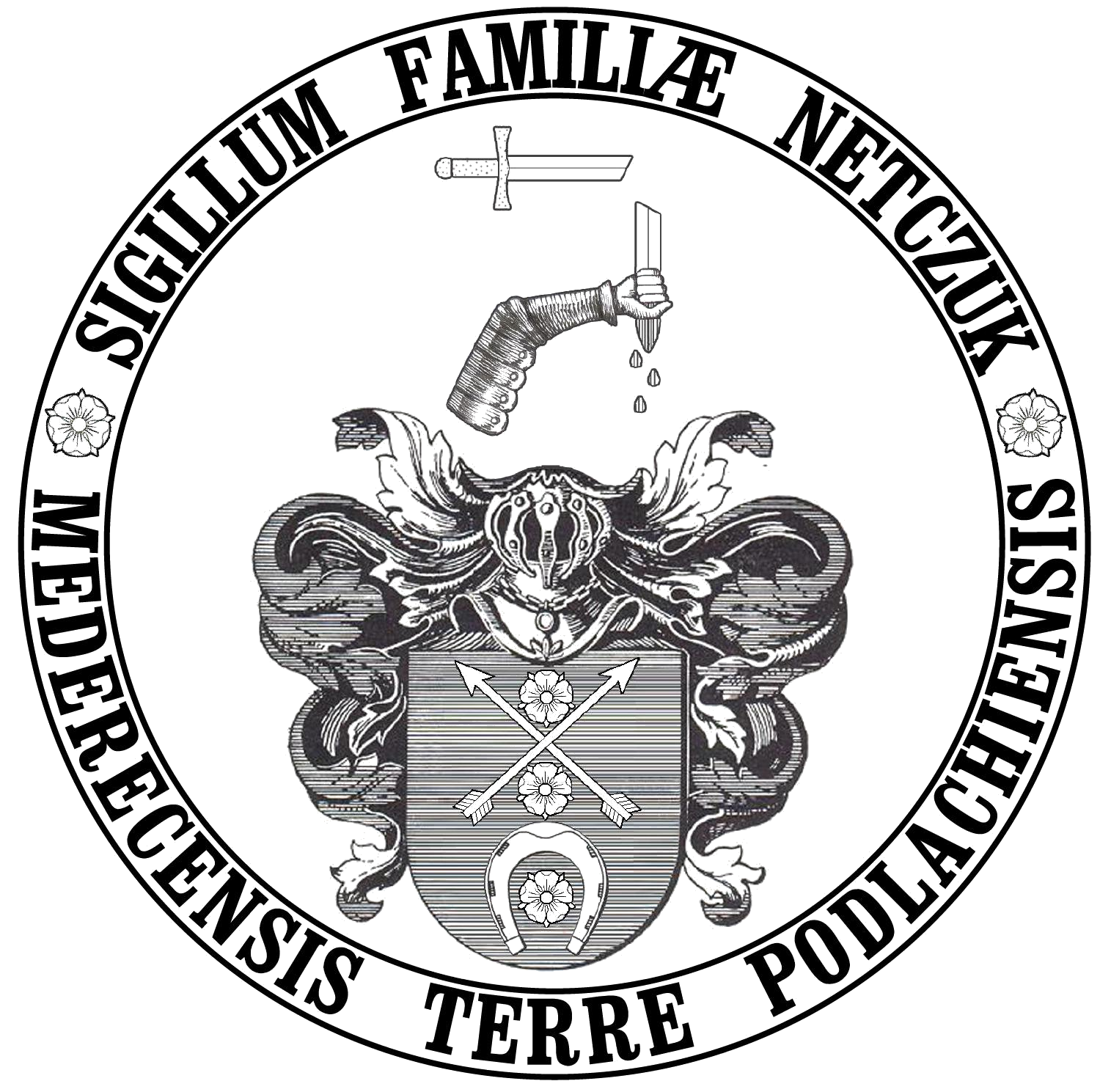
Members of the closest Kozar family in Międzyrzec, also called Naczkowicz and Sakowicz, as evidenced by court records, divide the rights to the Koszałczin house and land among themselves in the city court, which connects them with the Kozar family of Bracław and the Koszyłowska estate. Until the 19th century, they also used a seal that was a compilation of Doliwa - the coat of arms of Naczka Ginwiłowicz and the family sign of the Lithuanian Naczowicz family - Kościesza and Lis in numerous variations. Additionally, an entry from the Międzyrzec court book also mentions in their context the nickname Jiewszcza, worn by Jakub - a relative of the orphans Chwieda and Chwiedek Lieliejko (Piotr Lialusz was Piotr Naczka's cousin in the 15th century), and the nickname itself also appears on the seal of Piotr Naczka Ginwiłowicz from the first half of the 15th century (Jeuszcza). These court records link the Międzyrzecz Naczkowicz family with the Lithuanian Naczkowicz family. A direct connection is also found with the Vitebsk Kozar family, who came from Podlasie and Lithuania.
They took their local names, Kozar and Lisczyce, from estates granted to them in the late 15th century in Koziary and Lisiczyńce — two villages located between the extensive estates of the Zbaraski princes near Ożhowce (Nowy Zbaraż) and the castle in Toki, where they arrived with other Lithuanian families from Lithuania and Podlasie. They must have descended from one of Piotr Naczko's grandsons — the Naczowicz family, also known as the Sakowicz family. The patronymic Ostaszowicz, borne by the offspring of our ancestor Nacz Sakowicz, indicates descent from Stas Saka, perhaps identical with Stas Steckowicz Saka (Stanisław Steckowicz, standard-bearer of Medininkai in 1528), who was likely the son of Stecko Gedroiti Soka, mentioned in the Lithuanian Metrica, who is named after Ona Bagdona, the wife of Piotr Naczko Ginwiłowicz. Stecko was most probably the son of Grigory Naczowicz, mentioned in the third book of the Lithuanian Metrica, son of Piotr Naczko, son of Kimunt Ginwił, signatory of the Peace of Salin in 1398.
Our family, along with the Sakowicz family of Międzyrzec, thus arose as a branch of one of the numerous Lithuanian Naczowicz-Doliwite lines, traces of which can be found in 16th-century court records and in a family seal preserved until the 20th century. The origins of Kimunt Ginwił and Piotr Naczka themselves pose research challenges. Various researchers, based on analyses of Naczka's position on the Grand Ducal Council, have suggested descent from the Gediminas family.
The centuries-old, unique heritage of which our ancestors have always been aware, especially today, obliges us, the living, to preserve and pass it on to future generations, which is what the authors intend these pages to serve as, as a virtual monument in honour of our ancestors, constituting a contribution to the emerging monograph of the Netczuk family.
Łukasz Netczuk
representative of the Netczuk Family Club in Poland

Our pages
 |
Netczuk Family ClubThe website of an informal association uniting descendants of two major branches of the Netczuk family: the Podlasie (western) branch, originating in Volhynia, settling around 1550 in Międzyrzec Podlaski and scattered primarily in Poland, the USA, and Argentina, and the Volhynian (eastern) branch, scattered primarily in Ukraine, Russia, Canada, and the USA. The club's activities focus on conducting genealogical research, popularizing knowledge about our ancestors, and integrating all members of the family. |
 |
FB Netczk Family Club GroupThe forum was established in 2006, shortly after the first Netczuk Reunion. Since February 2022, the forum's function has been taken over by the Netczuk Family Club Group on Facebook. It serves as a platform for exchanging information and serves as an interactive communication platform for our family. New genealogical materials are published there, including complete trees and reports from reunions, trips, and family gatherings, available exclusively to registered Netczuk members. Therefore, we invite you to register with the Netczuk Family Club Group to enjoy access to all our resources. |
 |
Family HistoryA website dedicated to the genealogy of the Netczuk family, including its Podlasie (western) branch and its Volhynian (eastern) branch, as well as their descendants scattered around the world. Descendants of this ancient Ruthenian family, with roots in 16th-century Volhynia, currently reside in Poland, Ukraine, Russia, England, the USA, Canada, Argentina, Sweden, and possibly Kazakhstan. Considerable attention is also devoted to the history of the family's settlements and the genealogy of related families. |
 |
GenealogY IN MyHeritageThe most up-to-date and comprehensive genealogy of the Netczuk family and related families on My Heritage, built and updated since 2010, initially on the Moi Krewni portal. The database includes all our family trees, including collateral lines. The number of individuals in the tree exceeds 7,500. The website also includes photos, documents, literature, sources, and biographical materials. |
 |
Międzyrzec Podlaski - my beginningThe website currently under construction about Międzyrzec is based on materials collected by the author for his diploma thesis, "Międzyrzec Podlaski - Places of Life," which was defended at the Faculty of Architecture, Wrocław University of Science and Technology in June 2009. Particular emphasis is placed on the architecture and urban and spatial development of the city. The website will complement the Netczuk Family Genealogy and provide a graphic presentation of the settlement processes that shaped the city's present-day shape. The website is also intended to provide access to the author's extensive collection of iconography related to Międzyrzec. |
 |
Karniszyn - former townSite is about history of Karniszyn upon Luta Stream, its under construction now. Village is situated in urban-rural borough of Biezhun, district of Zhuromin, Masovia voivodeship, medieval Zawkrze District. Today village, in years 1519 - 1662 a city founded under German law with castle, erly medieval settlement, great potential and patronage of famous families, outmaneuvering nearby city Biezhun. On the site there will be materials, collected while long-term genealogical researches, together with genealogies of old and present karniszyn inhabitants - Czyzyk, Witkowski, Puszcz and other families. |
 |
Netczuk - a Family ApiaryThe website of beekeeper Tadeusz Netczuk. The apiary was founded in 1970 in Wrocław. In 1998, it expanded when it took over the care of Mrs. Wanda Mikrut's apiary in Przemiłów. In 1999, both apiaries—the Przemiłów and Wrocław apiaries—were combined and moved to Księginice Małe. Since 2000, they have operated in Księginice Małe and since 2017 in Zieleniec. For over 55 years, Tadeusz Netczuk's apiary has provided our family and customers with a wealth of clean, ecological products. |
 |
ArchiCons - ARCHITECTURE AND CONSERVATIONWebsite of Łukasz Netczuk and Ewa Netczuk-Pol, a research team of historical architecture. |
 |
Archive pagesArchive pages: Łukasz Netczuk's website 2004-2014 |